Sunday, 8 February 2015

Tuesday, 3 February 2015
Reconstructing the idea of childhood through a metaphor: Child is a Teacher of Life
Life is a never-ending school which no one can leave at his/her own wish. It teaches him to live in harmony with others, fulfill his responsibilities, take care of his/her loved ones and tackle difficulties sensibly. S/He is supposed to learn a new lesson everyday from the experiences s/he gets from his/her surroundings. But it is the basic nature of humans to forget the mistakes s/he commits and repeat it. S/He ignores her/his past and chases the future without learning anything from the present. I think that child is a teacher of life, a mirror which reflects how we should be and not what we are.
Often child is considered to be a blessing of God rather than an individual in its own right. But I feel children are as capable of having their own feelings and reactions as any adult around them. They have an urge to learn and share new things. Their raw mind is void of corrupted thoughts and so their actions teach us the most essential elements of behavior. This is where I think it is appropriate to express why I think that child is a teacher. Paulo Coelho said that “A child can teach an adult three things: to be happy for no reason, to always be busy with something, and to know how to demand with all his might that which he desires.” .When I recollect my memories from childhood, there are so many instances which make me realise that a child is truly a teacher in so many aspects of life. Childhood for me is that phase of life when a human not only learns how to nurture the social and ethical values but also teaches people around him/her that the happiness of life rests in its simplicity.
“Most studies find plurality of childhoods in India, varying with family structure, socio-cultural, economic and political setting, birth-order, gender, etc.” (Saraswathi, 1999; Chaudhary 2004, cited in Bisht, 2008, p.154).
True, as I think of my childhood, I understand that all these factors play a crucial role in moulding one’s life right from birth. The hierarchical system of families imbibes different cultural and moral assets in a child which s/he carries forward with pride and teaches the next generation too. When a child is born, with him takes birth a mother. She learns how to be patient when child does not obey her, not let her work, not let her take rest. She learns how to forgive even if the child hurts her physically or psychologically. She learns how to care and not expect anything in return. In other words, if I say that a mother is the first teacher of her child, then the child itself teaches its mother, the qualities which no other teacher in the world can inculcate in her. Defining childhood is a difficult task but I have tried to give my understanding of childhood based on my personal experience as well as observations.
Children are curious minds. Inquisitiveness guides them on the path of knowledge and plays an important role in future.We may not get answer to every question but to some and this is the best way to learn from observations and answers to endless questions. Children teach us that we will never learn if do not ask.A child does not give up when s/he makes a mistake. Instead, it looks into what went wrong and tries to avoid it next time. It indirectly shows us that mistakes are often openings to new experiences and lead us to progress later.
The ability to simplify matters and provide a productive way to solve a problem is very peculiar in children. It does not have the cognitive level of thinking so rationally but it needs reason to justify it. A child has respect and appreciation for everyone in its eyes. For him/her, everyone is special and of equal importance. For a teacher also every student is unique and he tries to give attention to each of them and make them understand in simplest way possible. A child lives in its world of imagination where possibilities are endless. It looks at the world with open mind and so nothing restrains it from thinking out of the box. If we present an adult and a child with a problem, the child will try to give the simplest perception while adult will complicate it because his/her imagination is confined by many factors such as society, family, emotions, status etc. But a child is the teacher who gives us the freedom to consider various ways of interpreting a difficulty.
Children delve into every aspect of their surroundings and look at every small thing which teaches them something and then they share it with others. Adults fail to make such observations because they have a macro-view of world and ignore things which do not matter to them directly. As we grow up, we forget how well we learned when we were young by simply observing others.One quality that everyone should definitely learn from a child is forgiveness. They are much unsullied and do not keep any bad feelings about others in their minds even if someone does wrong to them. They tend to forget easily and forgive without hesitation. As grown-ups, we start caring more about our self-esteem than the feelings of others and eventually end up losing relations.
I feel as we grow up, we learn how to conceal our feelings, manipulate them for our benefit and make it difficult for others to understand what is on our mind. But a child is honest to itself and to others about its feelings. It has that instinct to sense who is a good person and who has evil intentions. Children teach us that not only should we be true to our inner selves but also be honest to others because it avoids misunderstandings and helps us in being sincere in relationships. Loving unconditionally is very difficult because human being is selfish in nature. He seldom gives anything without expecting something in return. Whereas a child teaches us that doing little things for others and not anticipating anything in return gives more pleasure.
Having considered the prominent and possible characteristics of childhood that I have experienced and observed around, it is inevitable to discuss how a child develops into a civilized and cultured human being. It is also important to think about the factors which contribute to its growth in becoming what I have called a teacher and how the perception of childhood may vary from culture to culture and place to place.
To begin with the Nature/Nurture issue, I would like to give an example from my personal experience to explain this. I have a niece named Riya who is six years old now. When she was about two and a half year old, she started talking and would refer to her things in third person-“Riya’s doll, Riya’s dress”, etc. It was only after we taught her that she began saying “my dress, my doll”. Before that she used to give and share her stuff with other children in her vicinity. But once she started identifying things to be her own, she refrained from sharing her toys or clothes with anyone. This is where the nature/nurture part comes into play. The quality of sharing what it has, let it be some material or knowledge, is innate in a child. But when it grows up, we teach him/her to keep their stuff for themselves. We tell them not to disclose the knowledge that they have so that others do not benefit from it. Every child is noble and likes to spread whatever is in its mind. But the kind of upbringing that he gets decides to a great extent what he will become later in life. Thus, it is very important to nurture this beautiful attribute of sharing knowledge with others which is there in a child’s heart by nature.
While dealing with the Activity/Passivity issue, the debate may go like this- for example, some people think that being inquisitive about surroundings helps a child progress and become aware of reality that s/he is bound to face some day or the other which eventually is shared by her/him to help others, i.e. s/he plays an active role in building her/his personality as a teacher. On the other hand, it is also believed that external influence such as stimulating environment at home or in contrast, too much restriction on exploring world around develops this curiosity which makes the child what s/he is. This means the society has the most influential part in creating an individual. I think it is very important that a child has an active role in his learning years because what s/he learns from firsthand experience remains with her/him for a lifetime. But passive learning is something which may not seem significant that time but comes to its mind when situation arises like latent learning.
Continuity/Discontinuity issue is a bit confusing because the changes that occur during human development are not visibly obvious always. Let me take an example of a child who plays various games with his/her siblings. His/her mother gives him/her some innovative games which involve mathematical tricks. It interests him/her and he/she starts playing with numbers and teaches his/her siblings as well. This is a continuous change in his/her behavior since it also helps him/her in studies and acts as an exercise for the brain. On the other hand, as s/he grows up, the complexity of problems s/he faces increases but her/his skill to apply various methods on problems helps her/him and thus s/he builds up her/his knowledge in mathematics. Thus, although the capability developed continuously, the skills got more honed in stages which were discontinuous.
For explaining the Qualitative/Quantitative issue, I take example of a child who grasps languages very easily. When the child is about one year old, s/he learns his mother-tongue first. This is qualitative change as s/he learns how to express herself/himself. After s/he starts interacting with people in neighbourhood and school, s/he learns more languages, suppose Hindi and English as well. This is what quantitative change is which improves the quality of his competence of acquiring language skills with time and may help in becoming a proficient teacher in future.
The Universality/Particularity issue is quite interesting in the sense that it is not confined to various countries around the world but to various states within a country, various cultures within a state, various families within a culture and finally from individual to individual. The equality with which a child treats everyone let it be her/his parents, his siblings, his friends, the servants at his home, is something which we should learn and maintain throughout our lives. But this characteristic in a child depends largely on the culture he is being raised in. If I take an example of Indian society, at a very young age, children are not able to differentiate people into various classes that the society has created, so they respect and love all the people around them equally and this perspective of development is universal. But in many states and particularly in patriarchal communities, the female members are not treated well or in some families the servant class people are not even considered as human and highly disregarded. This has a bad effect on the children who tend to follow this trend which affects their behaviour for complete life. Thus, the socio-economic and family structure again has the maximum impression on how a child develops into a capable teacher of values in future.
Here, I want to share a story of a girl who actually inspired me to think of this metaphor for a child. For a child, love and caring from both mother and father is needed. But when one of the parents is not there, it becomes very difficult for a child to live in the society like any other child. When Ankita was just one year old, her parents got separated because of some personal issues. Even before she could recognize her father properly, she was taken away from him and brought to a place where everyone had question in their eyes. How they will survive without a man’s support, what her future will be without a father, how she will learn the importance of a family, and many such questions which made no sense to that child then. But as she grew up, she understood that something is not right. She learnt ignoring the painful comments made on her mother and her own existence. Indirectly she taught me that to sustain in the society, you have to overlook what is unimportant and which may hinder your own progress.
Her mother worked with a meagre salary. Ankita knew that her mother managed their livelihood alone so she never demanded anything to her. She learnt being happy with minimum possible facilities and just with the basic needs. She made me realise that being a part of a family, we should understand the crisis and try to help in whatever way possible. Even though she herself had very few things to play with, she never refrained from sharing it with others. She believed that the more you share, the more happiness you get. She taught me that when things go awry, we should just laugh and move on because worrying is not a solution to any problem. Rather looking at it positively helps and we can become better human beings at every stage of life. She showed me how to be carefree, how to live life fully without missing a single moment of joy and excitement.
Thus, for me child is a teacher of life who can change the way we live. After we grow and eventually forget the beauty of innocence and simplicity that childhood holds within itself, only a child can remind us of it again. Even though not directly, but just by observing them, we learn so many things about life that once we also went through but let them go with the continuous severe flow of life. I just wish that either my childhood comes back or the child which is still somewhere in me stays there forever and keeps teaching me new lessons everyday to enrich my character in various ways.
References
American Psychological Association. Frequently asked questions. Retrieved August 30, 2013 from http://www.apastyle.org/learn/faqs/index.aspx
Bisht, R. (2008). Who is A Child? The Adults’ Perspective within Adult-child Relationship in India. Interpersona 2(2), 151-172. Jawaharlal Nehru University. Delhi
Kakar, S. (1981). The Inner World A Psycho-analytic Study of Childhood and Society in India (Second edition). Delhi: Sage Publications
Shaffer, D. (2007). Developmental Psychology Childhood and Adolescence (Fourth Edition). California: Brooks/Cole Publishing Company
Child’s Representation of the World and its Effects on Education
Language cannot be defined in one way because of the enormous ease it provides us for expressing ourselves. But this simplicity in itself is very complex to understand. It is because of language that we are able to speak out what we think and operationalise our words into actions. A baby who has not yet learnt to speak cries or points to things so as to let others know its needs. Hence we cannot say that language consists of only spoken words. Language is also useful to represent experience.
James Britton says that the child gradually builds up a representation of the world in his/her head. If we try to think of the various elements that make this representation, we can say that it consists of symbols: names of objects and people; narratives; images acquired by the sense of sight, sound, movement, touch, smell and taste; images drawn from myth, religion and the arts; our feelings; our ideas and beliefs about the world.
Although there is no particular order in which these symbols may get organized in the mind, but putting name in the first place needs little explanation. When a child learns to speak, he does not all of a sudden start talking sensibly in grammatically correct sentences. Rather what he discovers first is the existence of the name for every single object around him. By the age of eighteen months, he starts uttering names of objects which are in his immediate environment without framing any sentences. Once the child knows the name and function of a particular object, he learns to categorize them which further help him in differentiating one class of things from another. Thus he faces less difficulty in re-classifying by adding new items to the language. The way in which colours are put into one category once he knows what is a color is the evidence of the fact that we could not handle experience at all if we did not first divide sense data into classes.
By the time the child is somewhere around three years old, his ability both to understand and to use words becomes more and more independent of the present situation. At earlier stage, it is the presence of objects that enables him to revive his past experience. But at a later stage he is able to name them in their absence, talk about them and even find them out physically. He starts referring to things and events that are not present but with which he is familiar.
Even though he begins to identify elements of his environment, it is quite interesting that he doesn’t recognize himself as an individual. He refers himself by his name and not “I”. But gradually as he recognizes his belongings and his relationship to others, he becomes aware of himself and thus a representation of his own identity is built up in his mind. To sum it up, while expressing himself, he puts not only the representation of world in front of others, but himself too. The child by this time has no such thing called inner dialogue which may lead him to think about expected actions to result in an anticipated outcome. But once he develops his own individuality, this inner speech comes into play and stimulates him to act in a certain manner which will give him a satisfying result.
Events are not permanent, it is the representation that prevails and keeps modifying itself because of addition of new experiences. Storing of the past experiences helps in recognizing the familiar aspects of the present and building up probability for the future. This experience is used to introspect into our representations so that we can make a sense out of it and also get others response on it. It is of utmost importance to rebuild the representation after listening to others’ experiences because what a child thinks of and behaves in a society depends largely on how he relates his representation of world with others and how well he accepts them.
The organization of these representations in the mind consists of multiple relations between various language structures. Similarity between events, objects, and a group of people helps the child to store such experiences together in one part of memory. For example, he can very well classify fruits, vegetables, colors, animals, festivals into separate classes. While likeness is useful in categorizing objects, oppositeness is another relation which makes it easier to develop a relation between objects and their properties. He realizes that sometimes associating an object to a feature it doesn’t have makes it more meaningful. Asking question in a negative tone when he is anticipating an affirmative answer is again a way of using oppositeness in representing his thoughts.
Hierarchy is one of the most important and widely used relations in language for representing the complex world in a simplified manner. It consists of representations in a generalized pattern just like similarity, oppositeness of objects etc. Keeping groups at different levels on the basis of common and striking features helps in formation of intricate thought process.
Grammatical relationships form one more part of this organization. It not only involves the relationship between various classes of parts of speech such as nouns, verbs and adjectives but also the syntactical relationships. The use of this relation in representing his world view helps him in constructing imaginary concepts. For example, he can talk about his experience in an amusement park by describing the giant wheel as a colorful, accelerating carrier of children to the heights of sky. His actual experiences come out more beautifully with the help of such imaginary thoughts about objects.
To answer over what span of time is this representation built up, it is difficult to trace the development. In the first few months, they learn to relate certain noises with happiness or distress. But there is no evidence if such noises are actually intended to communicate his feelings. At about three months, he starts playing with sounds that make some sense to him and by six months he even begins imitating sounds made by other people and to which he can connect something meaningful to his needs as well. By the age of eighteen months, as stated before he names and can even refer to objects and events in their absence after some days. But the representation of world in mind is a continuous process. Our experiences keep on adding to the existing ones and modify them to suit the present need.
Till now, we have brought up our discussion on the basis of what Britton has said about a child’s representation of world in mind. But there are some theories which although not completely opposite but have a different perspective about this idea. Let us see in brief what they say:
Noam Chomsky suggested that a child has the innate capability to grasp certain rules of sentence formation although the sentences may not be completely grammatical. He said that a child does not require much help and stimulus from his environment to learn language. Chomsky points out that a child could not possibly learn a language through imitation alone because the language spoken around them is highly irregular and adult’s speech is often broken up and even sometimes ungrammatical.
According to Jerome Bruner, a child first learns language and gains control over his speech. It is only after the ability to handle symbols that he achieves power of conceptualizing his thoughts. The organization of thoughts is done after the organization of words in speech. To put it in another words, a child first utters something and then inspects the difference between his speech and what he actually observes or thinks. Then he rephrases it and expresses in correct manner with the help of symbolic processes.
In his research on the cognitive development of children (1966), Jerome Bruner proposed three modes of representation:
- Enactive representation: It involves encoding action based information and storing it in our memory.
- Iconic representation: This is where information is stored visually in the form of images
- Symbolic representation: This is where information is stored in the form of a code or symbol, such as language. This is the most adaptable form of representation, for actions & images have a fixed relation to that which they represent.
He strongly believes that students are active learners who construct their own knowledge. Bruner, like Vygotsky, emphasized the social nature of learning, citing that other people should help a child develop skills. According to him, symbolic representation is very essential for cognitive development.
Piaget’s theory says something else. He says that a child first performs actions which lead to symbolic thoughts. After building up these symbolic thoughts, he develops the language capability. The work of Piaget on sensori-motor experience shows how a movement, once successfully accomplished, becomes interiorized to form a schema, and he relates this to imitative representation. He did not give much importance to adults’ role in child’s language development. He categorized the content of education as per ages of children which Bruner disagreed with.
We can associate this form of representation by a child, to his education in certain ways. The use of language as a representation of world begins from the day a child learns to speak and continues forever. Family members play a crucial role in developing the child’s ability to imagine and express his views openly. He learns his mother-tongue and finds less difficulty in adding up to it his new experiences. The actual problem arises when he goes to school. In school, he has to learn a common language which he might not be able to grasp quickly. This also hinders his thought process because he is not able to assimilate both the languages together into his imagination. Thus, schools should try to include child’s mother-tongue as well as a common language like English to help the child build up his representation easily.
When a child goes to school, everything starts from scratch and thus he is made to forget or wipe off what he has learnt before since infancy. Learning should never focus just on present and future prospects but also the past so that the child is able to include his knowledge and experience. The representation that he has made of the world before coming to school should act as a foundation for newer experiences and wisdom to be gained throughout his life.
As I have discussed earlier, speech follows the child’s conceptualization process. He starts talking more and more to people and to himself with the expectation of making his words meaningful and so as to get others’ response to his thoughts. In school, more importance is given to reading and writing because of which the speaking goes into background. This should not happen because learning by talking is very influential and impactful on the child’s mind. He interacts with people and comes to know more about the world and perspective of others too. Reading and writing alone to build up concepts in a language not familiar to him will only stop him from expressing himself. Thus in education, in early years, focus should be on making the child speak more and share his representation so that his peer group and even the teachers could add to it and help him modify the pre-built representation.
Narratives form one of the most significant elements in the child’s representation of world in his mind. His interaction with his family members, friends, neighbors and teachers together make up his view of the world. Not only the direct communications, but the overheard talks, mythological and fantasy stories, TV and radio telecasts, etc form a separate entity of representation in mind which he later uses for his own convenience. In education field, the inclusion of stage-plays, dramas, poem recitations and story-telling should be encouraged. The child finds himself in a responsible position when he acts in a drama; he has many images of certain characters, parts of a story in his mind which can actually help him in performing well. He can easily relate and remember the lessons being taught if he is made a part of it in a narrative fashion.
Thus we see that the significance of building up a representation of world in mind is the most essential part of a child’s learning process. Some of the academic debates related to this kind of representation have also been discussed and it can be observed that there is a parallelism in all the issues with difference in perception of how a child processes thoughts. I have tried to focus more on the educational implications of this concept and suggested some of the measures which can be implemented to improve the children’s ability to build their own ideas and outlook about the world and consequently perform better in all aspects of life.
REFERENCES
Britton, J. (1970). Language and learning. London: Allen Lane. [2nd ed., 1992, Portsmouth NH: Boynton/Cook, Heinemann.]
Britton, James. (1970). “Words and a World”. In Jones, Anthony and Mulford, Jeremy. Children Using Language: An Approach to English in the Primary School. London: Published for National Association for the Teaching of English by Oxford University Press. Pp.27-39
Langer, Susanne K. (1942), Excerpts from Ch.2,”Symbolic Transformations.” Philosophy in a New Key: a study of the Symbolism of Reason, Rite and Art. New York: A Mentor Book. Published by the New American Library. Pp. 32-41
McLeod, S. A. (2008). Bruner - Learning Theory in Education - Simply Psychology. Retrieved from http://www.simplypsychology.org/bruner.html on September 14,2013
Wednesday, 28 January 2015
Policies on Disability and Inclusion of Children with Special Needs in Education
Various policies concerned to Children with Special Needs in the context of national and international deliberations are briefly looked into in this article to get a broad understanding of the related issues. Neither is it exhaustive nor comprehensive but hopefully it will serve as a starting point for someone like me who had no idea regarding policies on disability.


The Right to Free and Compulsory Education (2009)
- The Mental Health Act 1987
- The Rehabilitation Council of India Act, 1992
- The Persons with Disabilities(Equal Opportunities, Protection of Rights and Full Participation) Act, 1995
- National Trust for the Welfare of Persons with Autism, Cerebral Palsy, Mental Retardation and Multiple Disabilities Act (1999)
- United Nations Convention on the Rights of Persons with Disability (2008)
- UNESCO Policy Guidelines on Inclusion in Education (2009)
- The Right to Free and Compulsory Education (2009)
- UGC (Promotion of Equity in Higher Educational Institutions) Regulations, 2012
The Mental Health Act 1987
This act consolidates the law relating to the care and treatment of mentally ill persons. It makes provisions for the safeguard of their rights, property and welfare. It also makes guidelines for the guardianship of mentally ill persons. It mandates the establishment of central and state authorities for licensing, establishing and supervising the psychiatric hospitals. It provides detailed guidelines for taking the custody of mentally ill persons who are unable to look after themselves or are dangerous to themselves and others. It regulates the procedure of admission and discharge of mentally ill persons to psychiatric hospitals and the authorities established under Ministry of Home Affairs (1987) are empowered to inspect the hospitals or any services offered to mentally ill to ensure their rights and the quality.
Mental illness too is considered as a disability in the Persons With Disability Act (PWD, 1995). The implication of these two acts on the education of mentally ill children is not clearly understood.
The Rehabilitation Council of India Act, 1992
The Rehabilitation Council of India (RCI) set up in 1986 was made a statutory body by the enactment of the above mentioned act on 22 June 1993. This act was amended in 2000 to make it more broad based. It is entrusted with regulating and monitoring services given to persons with disability, to frame appropriate curriculum and to maintain the database of all qualified personnels working in the field of Rehabilitation and Special Education of persons with disability.
It is necessary for institutions working for persons with disabilities to be recognised by the RCI. RCI sets the norms and guidelines for these Institutions and does the periodic assessments and accreditation for monitoring the quality. The curriculum that is offered in these institutions, courses of study and criteria for faculty appointment are all guided by the RCI norms for quality assurance.
Wide range of professionals like Audiologist and Speech Therapists, Clinical Psychologists, Hearing Aid and Ear Mould Technicians, Rehabilitation Engineers and Technicians, Special Teachers for Education and Training the handicapped, Vocational Counsellors, Employment Officers and Placement Officers dealing with handicapped, Multipurpose Rehabilitation Therapists, Technicians, Speech Pathologists, Rehabilitation Psychologists, Rehabilitation Social Workers, Rehabilitation Practitioners in Mental Retardation, Orientation and Mobility Specialists, Community Based Rehabilitation Professionals, Rehabilitation Counsellors/Administrators, Prosthetists and Orthotists, Rehabilitation Workshop Managers have to register themselves with the RCI to be eligible to practice their professions concerning persons with disability.
RCI Act was amended in 2000 to be in sync with the Persons with Disabilities (Equal Opportunities, Protection of Rights and Full Participation) Act, 1995. On the whole RCI is the apex governing body in India to ensure the quality of services offered to the persons with disability. It is also involved in promoting research in the area of disability. Its views on the inclusion of persons with special needs in regular schools is not known. How it is going to keep up with the same quality assurance and monitoring mechanism in the wake of Right to Education Act, 2009 also needs to be understood? Does it has the same authority over mainstream educational set ups in the country like the special schools is very unclear. As per RCI Act (1992) personnel dealing with persons with special needs without registering themselves are liable for punitive action. So the case of teachers handling the persons with disability in regular classrooms without registration is yet to be sorted. This confusion has severe negative consequences for the quality of education for those with special needs.
The Persons with Disabilities(Equal Opportunities, Protection of Rights and Full Participation) Act, 1995
India became a signatory to the proclamation on the Full Participation and Equality of People with Disabilities in the Asian and Pacific Region during 1992 at the meeting in Beijing to launch the Asian and Pacific Decade of Disabled Persons (1993-2002). To implement this proclamation the above mentioned act was enacted by the Indian parliament. This act defines disability as blindness, low vision, hearing impairment, leprosy cured, loco-motor disability, mental retardation and mental illness.
The act calls for the setting up of two committees at central and state level. one is the coordination committee and the other is an executive committee. Coordination committees are required to ensure the rights of persons with disability by advising different government bodies for necessary changes in the policy and practices and the executive committee is responsible for carrying out the decisions made by coordination committee.
It stresses on the significance of prevention of disability at the early stages itself and needs the government to screen all children at least once in a year to identify potential factors that may lead to disability in the long term. It also mandates the government to take all measures to prevent disability occurring at prenatal and postnatal stages. The act makes the government responsible for providing non-discriminatory environment like adapting railways, buses, road signals, building ramps, braille signs and auditory signals etc to suit the needs of Persons with disability.
The act also says that children with disability should be provided with free education until the age of 18 by the appropriate government. It says that government should make provisions for integrating these children in regular schools along with schools exclusively meant for them. It also requires state to make provisions for educating such children through non-formal education and vocational programmes. It mandates 3% of seats to be reserved in educational institutions and public sector employment.
National Trust for the Welfare of Persons with Autism, Cerebral Palsy, Mental Retardation and Multiple Disabilities Act (1999)
As per the above act an autonomous organization was set up under the Ministry of Social Justice and Empowerment of Government of India. The National Trust was set up to find an answer to the worries of parents - “What will happen to my child when I am no more?” Here child refers to child with anyone of the disability like Autism, Cerebral Palsy, Mental Retardation and Multiple Disabilities. Given the inability of these children to make decisions in life it has provisions for their care and protection in the event of death of their parents or guardians. It has evolved comprehensive procedures for the appointment of guardians and trustees for persons with such disabilities. It also extends support to registered organizations to provide need based services during the period of crisis in the family of persons with such disability. Apart from this its other stated objectives are as follows.
- To enable and empower persons with disability to live as independently and as fully as possible within and as close to the community to which they belong;
- To strengthen facilities to provide support to persons with disability to live within their own families;
- To deal with problems of persons with disability who do not have family support;
- To facilitate the realization of equal opportunities, protection of rights and full participation of persons with disability.
It implements its objectives through government departments and local bodies, registered organizations and its own grassroot wing called local level committee at the district level.
How do we view the National Trust Act in the context of Inclusion of children with special needs in Education? It acknowledges the fact that there are going to be certain persons with disability who remain heavily dependent on the community for rehabilitation. Inclusion of children with special needs in education will help build a well informed community which can further play a proactive and vigilant role in the welfare of such people.
United Nations Convention on the Rights of Persons with Disability (2008)
As per this convention disability is seen as one which results from the interaction between a person’s impairment and obstacles like physical barriers and negative attitudes that prevent their participation in the society. It takes us from viewing persons with disabilities as objects of charity, medical treatment and social protection towards viewing them as ones with rights, capable of claiming those rights and making decisions for their lives based on their free and informed consent while also being active members of society. So this convention marks a shift in the way disability is perceived, as a social welfare concern to a human rights issue. It aims to protect, promote and ensure the full and equal enjoyment of all human rights by persons with disability. It emphasises that it is the social barriers and prejudice that are disabling not the impairment alone. Hence argues for accessibility, personal mobility, health, education, employment, habilitation and rehabilitation, participation in political life, equality and non discrimination for persons with disability. This convention sets the stage for full scale inclusion of the persons with disability with the mainstream society.
India is a signatory to this convention and it is legally binding to implement the legislation of the convention.
Policy Guidelines on Inclusion in Education (2009)
To serve as a resource for policymakers, teachers and learners, community leaders and members of civil society in their efforts to achieve Education for All goals, these policy guidelines were arrived through International Conference on Education in Geneva, Nov 2008.
Assistant Director-General for Education of UNESCO , Nicholas Burnett in the foreword to this document writes the aim of inclusion in education is to eliminate exclusion that is a consequence of negative attitudes and a lack of response to the diversity in race, economic status, social class, ethnicity, language, religion, gender, sexual orientation and ability. Inclusive education is considered as very central to the achievement of high quality education for all learners and the development of inclusive societies. Education of persons with special needs is placed here within the larger framework of many other factors which is very much essential to understand the issue holistically. This will initiate us to examine the issue in terms of religion, in terms of gender, poverty, race, ethnicity etc separately which enables us understand the status of persons with special needs from multiple perspectives. This multi perspective approach will be most effective way to ensure the rights of persons with special needs.
In this document inclusion in education and quality of education are said to be reciprocal (p. 10). In other words access (not just physical) and quality of education are mutually reinforcing. Further the quality of education is said to incorporate two important conceptual frameworks. One is the cognitive development of the learners and the other is the promotion of values and attitudes for responsible citizenship. Currently when we are in state of dilemma whether to educate persons with special needs in an exclusive educational setting or not. I identify the root cause of this dilemma or anxiety to the quality of education. Without enough training to the personnel in the mainstream educational setting, without necessary changes in the curriculum, without the functioning mechanisms already in place in terms of diagnosis, infrastructure and grievance redressal we are in a hurry to put all the diverse individuals in one place to meet international commitments on inclusion in education. The rights of persons with special needs will be better ensured in an exclusive quality educational provisions than in the poor quality mainstream education. So any attempt to bring in inclusion of persons with special needs should be preceded with improving the quality in the mainstream education.
Recognising curriculum as an important factor in Inclusion in education this document suggests inclusive curriculum to be based on the principles of non-discrimination, appreciation of diversity and fostering tolerance. It should also reflect the visions and goals of wider development of that country (p. 19). Such a curriculum will be sensitive to the diversity of issues mentioned already. So the emphasis is not on forcibly training or educating the persons with special needs to meet the criteria of standard curriculum instead it about evolving a curriculum that suits the needs of diversity in the pupil.
The document draws its attention towards negative attitudes of teaching and non teaching staff along with parents and the families of a pupil as a major barrier to the inclusion in education which has to be addressed through continuous in-service professional development (p. 20). Given the vulnerability of persons with specials needs the suitability of the personnel (both academic and non academic) who are made responsible for them should be ensured even before giving them the task of educating them.
India is a founding member of the UNESCO since 1946. Article VII of the constitution of UNESCO requires that “each Member State shall make such arrangements as suit its particular conditions for purposes of associating its principal bodies interested in educational, scientific and cultural matters with the work of the Organization”. Hence this document holds lot of significance in the way Indian state considers inclusion in education.
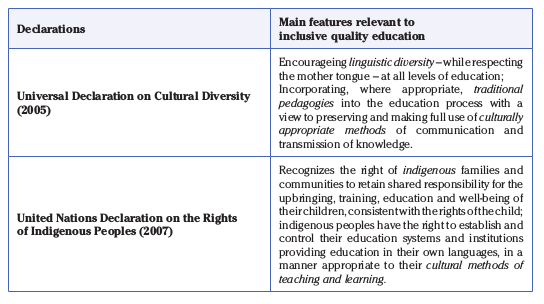
Also Inclusion in education is a direct consequence of various international conventions, recommendations and declarations for which India is a signatory. Here Inclusion explained and understood through Human Rights framework. The overview of these is illustrated below.

Also Inclusion in education is a direct consequence of various international conventions, recommendations and declarations for which India is a signatory. Here Inclusion explained and understood through Human Rights framework. The overview of these is illustrated below.
The Right to Free and Compulsory Education (2009)
Under this act now it is the right of the children with disabilities to avail free and compulsory education in regular schools. As per this act a child with disability is defined as follows:
- A child with disability is to be included in the Act's definition of children belonging to a 'disadvantaged group'.
- A child with 'disability' as defined in 1995 Persons with Disabilities Act
- A child with 'disability' and 'severe disability' as defined in National Trust for Welfare of Persons with Autism, Cerebral Palsy, Mental Retardation and Multiple Disabilities Act, 1999.
The provisions of the RTE for the disabled children are in consonance with the UNESCO guidelines on the Inclusion in Education. The problem arises in the implementation stage. Most public schools already had the issues with the quality of education provided. So the inclusion of children with special needs has only worsened the situation as per the status report RTE 2013. The following are the important findings related to the status of the RTE implementation with respect to the children with special needs (p. 177).
- Most teachers in regular had no training with regard to the inclusion of children with special needs.
- The infrastructure did not meet the needs of Children With Special Needs (CWSN) like toilets, drinking water facilities, ramps etc
- The aids and appliances provided to the CWSN were of poor quality and the ones provided were kept in resource centres and children were not allowed to take them to their homes.
- The visits by the special education teachers to the regular schools was very rare.
- Regular schools had limited vision with respect to inclusion of CWSN.
Teacher shortages, very high pupil teacher ratio, non availability of special teachers on daily basis, non availability of learning resources suitable to CWSN are cited as major drawbacks in the implementation of RTE for CWSN.
UGC (Promotion of Equity in Higher Educational Institutions) Regulations, 2012
UGC (Promotion of Equity in Higher Educational Institutions) Regulations, 2012
The meaning of the word ‘Equity’ referred here in these regulations made by the UGC is same as the word ‘Inclusion’ referred in the above two documents. These regulations will apply to all the higher educational institutions in India. It says ‘Equity’ means a level playing field for all the students in respect of the entitlement and opportunity for enjoyment of all legitimate rights. It states such a level playing field will be free from any discrimination or harassment. These regulations define the word ‘Discrimination’ as any distinction, exclusion, limitation or preference which has the purpose or effect of nullifying or impairing equality of treatment in education and in particular
- of depriving a student or a group of students on the basis of caste, creed, religion, language, ethnicity, gender and disability of access to education of any type or at any level;
- of imposing conditions on any student or group of students which are incompatible with the dignity of human; and
- of subjecting to the provision of establishing or maintaining separate educational systems or institutions for students or groups of students based on caste, creed, religion, language, ethnicity, gender and disability.
Further the word ‘Harassment’ is defined as any unwanted conduct which persistently demeans, humiliates or creates a hostile and intimidating environment or which is calculated to induce submission by actual or threatened adverse consequences.
These regulations mandate every higher educational institutes to take appropriate measures to promote equality among students of all sections of the society. It further instructs to educate the educational fraternity and public by raising public awareness on the importance of equality and overcoming any form of discrimination and harassment against students belonging to various sections. The word ‘Equity’ is defined here through Human Rights framework which is same as what the word ‘Inclusion’ means.
References
Soni, R. B. L. (2013). Status of Implementation of RTE ACT-2009 in Context of Disadvantaged Children at Elementary Stage. New Delhi: NCERT. Retrieved from http://www.ncert.nic.in/departments/nie/dee/publication/pdf/StatusreportRTE2013.pdf
Ministry of Social Justice and Empowerment. (n.d.). The Persons with Disabilities (Equal Opportunities, Protection of Rights and Full Participation) Act, 1995. Retrieved from http://socialjustice.nic.in/pwdact1995.php
Mental Health Act, 1987 - Description. (n.d.). Retrieved from http://www.medindia.net/indian_health_act/mental-health-act-1987-description.htm
National Trust. (n.d.). Frequently Asked Questions on Disability. Retrieved from http://thenationaltrust.gov.in/index.php?option=com_content&task=view&id=77&Itemid=131&limitstart=5
Ministry of Law, Justice and Company Affairs. (1992). The Rehabilitation Council of India Act, 1992 (No. 34 of 1992). New Delhi. Retrived from http://www.rehabcouncil.nic.in/writereaddata/rciact.pdf
United Nations. (2006). Convention on the Rights of Persons with Disabilities. Retrieved from http://www.un.org/disabilities/convention/conventionfull.shtml
UNESCO. (2009). Policy Guidelines on Inclusive Education. France: UNESCO. Retrieved from http://unesdoc.unesco.org/images/0017/001778/177849e.pdf
UGC. (2013). UGC (Promotion of Equity in Higher Educational Institutions) Regulations, 2012. Retrieved from http://www.ugc.ac.in/pdfnews/2147890_gazetteequity-Eng.pdf
Subscribe to:
Posts (Atom)